 This postcard is my most recent purchase. It's an image of The Depot taken from The Fishpond. To the right, you can see the stairs to The Lodge. The men in the center look like either baseball players or gardeners. There are 2 trolleys waiting at The Depot. It's a nice black and white postcard, but unfortunately it was not dated nor was it postmarked.
Here are a few links to previous posts with images of The Depot: Depot 1, Depot 2, and Depot 3
 This photo was taken standing on the hillside behind the fishpond area. You can still see the landing area of The Depot as well as part of The Loop. That's The Promenade going off to the left there.
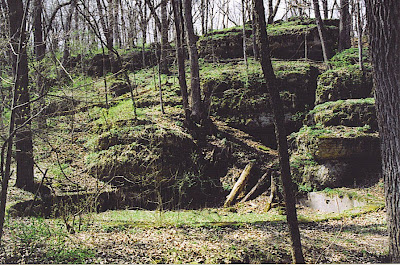 This springtime photo of the fishpond is one of my favorites. You can clearly see the outline of the pond itself. It must have been beautiful in its heyday.
Here are the links to the images that were posted previously: Fishpond 1 and Fishpond 2
 This postcard features another inside view of Wonder Cave. Compare it to the postcard from an earlier post.
 Here is another view of the stairs to Wonder Cave. It was taken in the spring of 2005 so there is less vegetation in the photo than in the other post which was taken during late summer of 2003.
 This item of interest is what remains of one of Union Park's original light posts. What's really cool is that a tree has grown around it. It's one of the few remnants of a time gone by. Its location is in what used to be The Children's Playground area.
 This is a very similar scene to the one in the previous post. It's a photo of the path to the restrooms.
 This postcard is entitled "Scene in Union Park Dubuque, Iowa". I have not been able to find an exact match for this scene. My guess is that it's the sidewalk that leads to the restrooms, but then again I could be wrong. If any one knows where this scene is in Union Park, please send me an email.
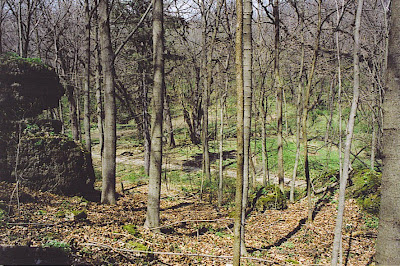 Here is another view of The Pavilion area from a slightly different angle. The Promenade cuts through the park passing by the Triangle Garden and the Tree with Three Trunks. You can also see the area where the Ice Cream Stand and the Bowling Alley stood.
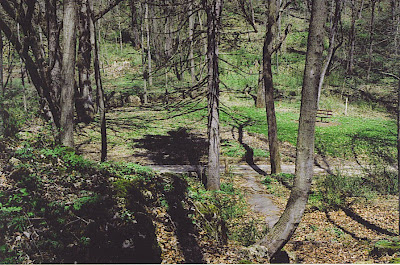 This image is very similar to a previous post "The Pavilion, Union Park" which posted on 10/26/09. The Triangle Garden and the Tree with Three Trunks are both visible. Also, you can clearly see the meandering creek which would have passed under the building.
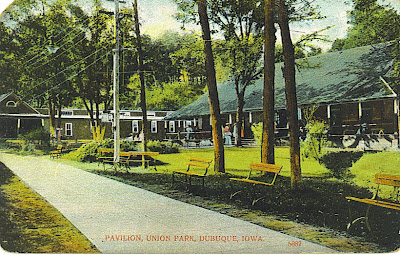 Picture yourself walking down The Promenade. Here in this scene you can see The Pavilion off to your right. Notice on the far right how the creek meanders under the building. Further down the sidewalk past the Triangle Garden is The Ice Cream Stand and The Bowling Alley.
Can you spot what is missing from this image? Answer: The two water fountains. Even under magnification, I can't find them. Perhaps this photo was taken before the installation of the fountains. Since this postcard was never used, it is difficult to determine when it was taken.

 These photos were taken standing at the far western end of the park where the sidewalk ends in The Children's Playground. This ends our walk through Union Park, but it is not "The End". From time to time I will post additional photos, articles, and postcards. I hope you have enjoyed your tour of Dubuque's very own amusement park!
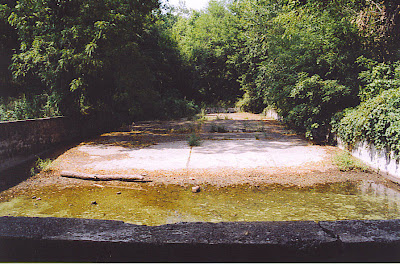
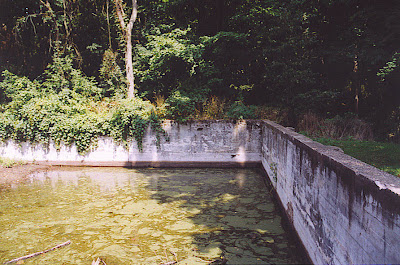 After the 1919 flood the Death Pavilion was never rebuilt. A swimming pool replaced it. The photos above were taken in late August, 2003. I have not been able to find an image of the swimming pool in use during the time Union Park operated. If you have such an image and would like to share it, please send me an email.
 This is the area where the Death Pavilion once stood. If you compare this photo to the postcard from the previous post, you can see the same steep terrain in the background. This photo was taken in the Spring of 2005.
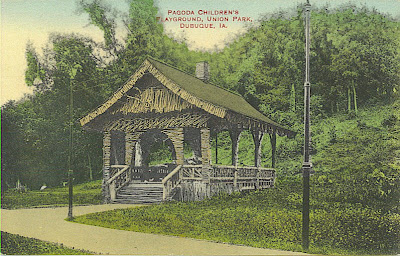 This is an image of the pagoda in The Children's Playground that later became known as "The Death Pavilion." It was built in the same rustic style like the other picnic pavilions and bandstands in the park. During the flood of 1919 it became detached from its foundation and crashed into the Wading Pool. A total of seven people died in Dubuque on that fateful day including five at Union Park. The Death Pavilion was never rebuilt. This postcard was mailed in 1912.
 This photo taken in 2008 and shows the playground as it appears today. That's the sidewalk on the right hand side. Looking at the center, you can just see the outline of the Wading Pool. There are probably a few more trees in the play area than there were during its heyday, but it's still a great place for kids to play.
 The far end of the park is depicted in this scene. The rustic style pavilion or pagoda on the left later became known as "The Death Pavilion". It was used for picnics until the 1919 flood when it floated away. The park had at least two sandboxes with covers that could be lowered each night. This card was postmarked in 1909.
 This is a photo of the wading pool as it appeared in the Fall of 2008. The cement work is actually in very good condition although it's difficult to see with all the mud. This photo is taken facing towards the entrance of the park. As you can see the water stagnates in the pool. There is a small trench or crack in the upper left hand side of the pool; the trench was put in to drain the water. The plumbing is still intact, but is plugged up.
The dirt is encroaching on the top of the cement and covering it up. If it is not cleared soon, plants will start to grow and the pool will deteriorate even more. You can already see that happening on the lower left hand side of this photo. Hopefully, someone will clean up the debris one day.
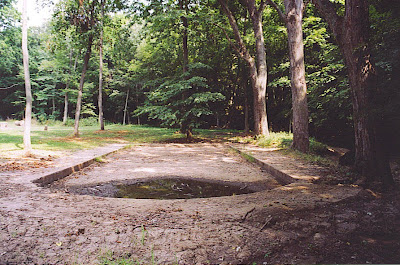 Here's another view of the Wading Pool taken during the summer of 2003. Note the tree at the end of the pool where the picnic pavilion once stood. Also, a crack in the wading pool is visible on the right-hand side; the idea was to drain the standing water in the pool. However, as you can see, water still accumulates there. Additionally, the pool is often caked in mud during different seasons.
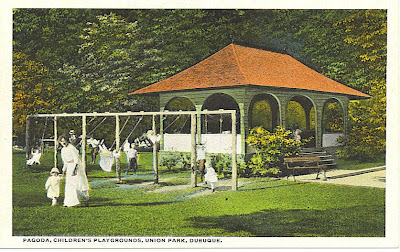 The Pagoda or picnic pavilion in this scene was located at the west end of the Wading Pool; it replaced the benches that were visible in a previous post. I'm still researching the construction of this pavilion. From the clothing of the young woman and children, this postcard appears to have been taken after 1910. The set of swings were there before the pavilion was built.
 This postcard is my most recent purchase. It's an image of The Depot taken from The Fishpond. To the right, you can see the stairs to The Lodge. The men in the center look like either baseball players or gardeners. There are 2 trolleys waiting at The Depot. It's a nice black and white postcard, but unfortunately it was not dated nor was it postmarked.


