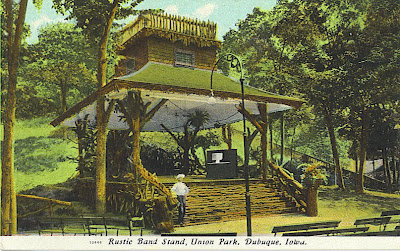
 Here is another image of the second bandstand. It offers a better view of the rustic style which incorporates rough-cut branches into the trim and as support columns. There is an upright piano on stage. The man in the image looks familiar; perhaps he is the same individual pictured in a few of the earlier posts.
In the background, the stairs to the Miner's Hut is visible. Also, to the far right you can just see a pavilion.
 The copyright for this image is 1907 by F. L. Egelhof. It is titled "RUSTIC BAND STAND, UNION PARK, DUBUQUE, IOWA. U.S.A." As in his previous images, Egelhof photographed Union Park in its early days. In the upper right-hand corner of this postcard you can barely see a toadstool-shaped pagoda or miner's hut. This is the same miner's hut pictured in an earlier post "The Miner's Hut, Union Park."
This is the second Rustic Band Stand built in Union Park. The original was across from The Pavilion. The plaza area is not pictured in this postcard, but will be visible in an upcoming post. This band stand was a very popular aspect of the park before the Mammoth Theatre was built. Music and plays were the typical forms of entertainment offered. In fact, if you look closely there is a piano and a few chairs on the stage.
I was unable to read the sign posted on the stairs. If anyone knows what it says, please email me.
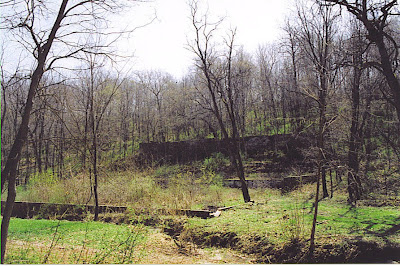 I took this photo from the northwest corner of the Dance Hall. I was standing on The Promenade facing the Dance Hall. You can see the retaining wall in the background. Also, in the front of the photo, you can see where the creek is meandering along its new path along the dance hall foundation.
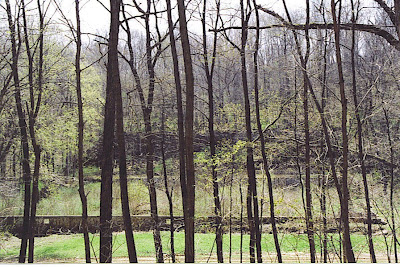 In this photo taken in early Spring of 2005, you can see the outline of the Dance Hall that replaced the Mammoth Theatre. Also, you can just barely see The Promenade at the bottom of this shot. I took this picture standing on the northern slope of the park looking down. Normally, during the Summer and Fall, there is too much foliage to see the remains of the building well.
 This is another image of all that remains of the former Dance Hall that replaced the Mammoth Theatre. Plants and shrubs have taken over the structure.
 After the flood of 1919, the Mammoth Theatre was torn down and replaced. Instead of cutting the hollow in half, a new building was constructed along the south side. Due to the decline of interest in theatre entertainment, its function was as a Dance Hall. When Union Park closed, the building was torn down. The Dance Hall floor was reused in Dubuque's new ballroom called Melody Mill. Eventually Melody Mill was torn down as well (in 1964); however, the dance floor was again saved. It is still used today at the Dubuque County Fairgrounds Ballroom.Pictured above are the stairs as they appear today. Note the chunks of sidewalk which made up The Promenade. Years of exposure to water and the elements have caused the cement to crack and the pieces have been gradually pushed along the creek's path.For more information about Melody Mill (including photos), visit Encyclopedia Dubuque
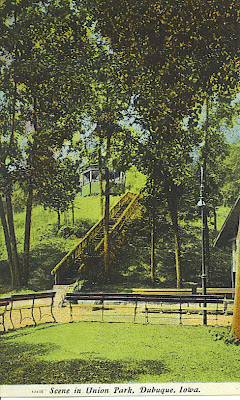 This undated postcard, "Scene in Union Park, Dubuque, Iowa" has a great view of one of the original Miner's Huts. It was located to the right, just past the Bowling Alley, as you walked down The Promenade towards the Children's Playground. Remnants of the stairs still exist; however, the railing was removed long ago. Also, there are many more trees on the hillside currently. It's actually quite steep.
 Here is another image of the second bandstand. It offers a better view of the rustic style which incorporates rough-cut branches into the trim and as support columns. There is an upright piano on stage. The man in the image looks familiar; perhaps he is the same individual pictured in a few of the earlier posts.


